Friday, June 12, 2009
The making of Bjork's Wanderlust
I recently came across this behind the scenes look at the Bjork 3d video, Wanderlust. It's by a group named Encyclopedia Pictura, and it's an amazing feat of multidisciplinary creativity (and mushrooms). Some time last year they gave a talk at Horizons - a conference on psychedelic drugs that I arranged some videography for. They incorporate 3d recording and playback, large scale puppetry, clay, choreography, green screening, and 3d compositing to achieve an amazing texture and visual quality.


Wednesday, June 10, 2009
Images on Jet Propulsion Lab site open for use
I spent some time working on a site design for someone where the theme of space was tossed around a bit. I did some research and found that the Jet Propulsion Labs (a branch of NASA) - perhaps because they're publicly funded or something - allow for the open use of images gathered from satellite and robotics missions. There are a few stipulations, but giving someone a credit line for some amazing images seems like a more than fair price to pay. They even have a nice little flex gallery for browsing their collection and offer both high rez Jpgs and Tiffs.


I'm pretty sure that - within these stipulations - an artist would even be able to use these images as source material to photoshop to their hearts content, but rather than give you incorrect legal information here I'll just direct you over to the JPL's Image Use Policy so you can see for yourself :)
Sunday, June 7, 2009
Code package management in flash and eclipse
There was a time where I'd have a copy of a framework or as3 code package in the folder of every project I'd use it in. This wasn't a big deal, until I did a search one day and realized I had about nine copies of Tweener strewn about my harddrive - a situation ridiculous enough to merit change.
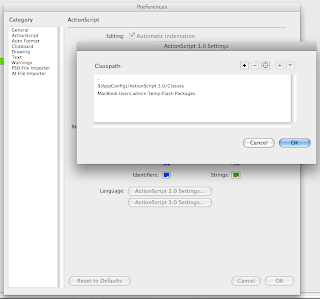
There are also a number of token/variable things you can use to represent certain important locations. If anyone knows of more, let me know:
I created a folder named Flash Packages, and copied every bit of code I reuse (or even might) to it. In the flash IDE the change was simple enough - add this new folder to your list of classpaths. To get there you open Flash's preferences, navigate to the Actionscript panel, and - under the "Language" label - click on the button for Actionscript 2 or 3 respectively. This will alter the global classpath (affecting every flash document you create in the IDE). Settings for the document-level classpath can be found in the Publishing settings. Add your new created and sorted package folder to the list and you're done :)
What's more interesting, however, is the fact that you can add relative paths as well. There's a default entry of "." which causes every FLA to include any classes in it's own directory, while an entry of ".." would cause the directory's parent to be searched.

There are also a number of token/variable things you can use to represent certain important locations. If anyone knows of more, let me know:
- $(AppConfig) - Flash CS3 configuration folder, which contains default Actionscript classes
- $(LocalData) - Not exactly sure where this one points
My workflow includes both flash and the Eclipse editor, though, and for the longest time I couldn't figure out how to mirror this kind of change in it's environment. Just found out how to do it, though, and it's pretty easy. Just add a folder to your project (New>Folder), click the Advanced button, and set up the option for "Link To Folder In the File System" :) This is where you'll add packages from the folder of actionscript libraries you created earlier.
Web 2.0 Mission Statement
Was clearing out some old papers and came across some ideas I'd doodled on paper while working out the concept for an editing project I did over a year ago where I mixed animated flash content, screen captures of various websites, and live video. Thought it might be cool to share the two together. Make sure you watch it in high quality :)

Concept, Editing, Animation - Will Saunders Producer, Copy - Lee McAlilly 3d Animation (Not seen here) - Broadway Romero Additional Editing - Jeltron
Monday, June 1, 2009
In with the crowd.
Despite a certain article I read on FreelanceSwitch recently about the downfalls of spec work, I've joined a crowd-sourcing site. If you don't know, crowd-sourcing is when a job - normally given to a business or freelancer - is outsourced to a large mass, usually the community of a website. Designers competing for jobs, basically. The writer sites the one I joined as an example, which is run by another blog I read a lot geared towards web designers, and - amazingly enough - explains the head-explodingly meta case of another crowd-sourcing site obtaining their logo in this manner from this one (and ultimately only paying around $200).
This case - as ridiculously ironic as it is - would drive anyone to a strong opinion, but at the end of the day it still stands that everyone involved is a grown-up designer. In other words, this site can't be seen as more than a tool and any tool looks bad when used improperly. The most obvious use case for these sites - in my opinion - is passive income. I, however, choose to see them as an opportunity, if you will. I believe the number of contests requiring logos far outweigh the others, but branding is something I'd like to get (more) into anyways. A number of things will have to be kept in mind if this is to make any kind of sense, however -
- These are little, self-contained, modular experiments in design. I can walk into them open minded and unburdened, and - after the alloted amount of time - leave just the same. I have to remember that ultimately, I'm just here to pimp the system.
- I must manage time. I could be the best logo designer in the world but the cost/risk/payment ratio is so skewed that it wouldn't make sense to spend too much time or rely too heavily on these things. Also consider the fact that my 30 minute idea has gotten a more positive response from the contest holder than two I did for another that took significantly longer.
- What makes these "exercises" particularly potent is the fact that it's an amalgamation of design and branding, so it's not just the photoshop experience I'm after - it's also ability to do this type of high-level conceptual thinking involved with quickness and agility. A terribly beneficial aspect, despite the fact that I would probably outsource this kind of task to someone else myself if a client were to ask for it.
- Though this site won't teach me the value of design, I'll certainly learn a lot by seeing the designs of others and - more importantly - see how ideas can be realized, hybridized, and cannibalized, and where the fine lines in the sand between the three lie. Already I can see familiar concepts applied in new, interesting ways I wouldn't have thought of, examples of people taking my concepts and running with them, and comments from designers to designers about what they consider to be imitations of theirs.
- That ultimately this is supposed to be fun, and that I'm not concerned with the $200 that could - in some cases - not be paid at all if the contest holder doesn't find a design they like. By keeping this in mind I'll be more likely to stop and change direction if it's just not working out or even just keep the designs to myself.
- If I manage to get good at this, I can sell designs on the back hand - through a logo shop or an asset store - a site where people purchase pre-made components for use in their projects.
- It gives me (a) perspective on what people consider a logo. It's important to understand parameters and trends so you can make the decision when to fit your work within their constraints and when (and how) to break/stand out. Speaking of trends, I think this list will cover most of them you'll come across - easily (or unfortunately) enough.
As I said before - logo creation might not be something I'd hesitate to bring in a specialist regarding, but the state of the art has definitely elevated to the point where the website - traditionally a source of relatively static information, now has just as much to do with a brand as a logo - and is indeed the first point of contact people have with both. I suppose this is more of a strategic exercise then, if that's the case.
Thursday, May 21, 2009
Auteur theory (2.0)
Film - though a medium well over one hundred years old - is still riddled with everlasting debate of the Auteur Theory, or the question of whom the creative direction belongs to on a film. A hundreds years is actually pretty young in the context of other cross-disciplinary collaborative arts like architecture. I wonder why - with this debate so common-place in film - is it not as heavily milled over in web-design, a similar but far less ripe medium. The director steers the ship according to the Auteur Theory. What's the equivalent in web design? It's an important question to consider in the face of highly trained artistic teams who craft fully immersive experiences. At this point I'm sure a boutique design agency somewhere has justified the cost of a 35mm film shoot for the sake of a site and a site alone.
What makes this parallel even more interesting is the fact that film (ok ok...video) is undergoing a radical shift in the exact opposite direction - while websites are becoming more complex and members of web-design teams increasingly specialized, the craft of "filmmaking" is now subject to fewer barriers to entry than ever. Cheap(er) "prosumer" cameras with high resolution chips and well-rounded video production software packages make it easier for a single person to manifest a vision. Think of what you get with the Final Cut Suite (editing, compression, titles, scoring) now compared to your cheapest low-end Avid (editing) from years ago. Meanwhile the average flash designer now has to get up on Flex, integration with back-end data services, and have the ability to do 3d math. It's no wonder these teams are becoming more granular, and though perhaps we've boiled the question down a bit this much still stands - is it better to be the lone artist or part of a well oiled machine?
Firstly I wonder about a team's capacity to push the envelope. While more people on a project definitely increase the chances for groupthink, with the right people the process evolves into an iterative collaboration with each person elaborating on the last's ideas until the whole becomes more than the sum of it's parts. I suppose I've always been attracted to the idea of agencies or companies that encourage play, also. Google employees have a certain amount of time they're allowed to devote to projects of their choosing, and a person with the distributed support of a team probably has more time that sort of thing, in theory. Despite all the rationalization in the world, however, this much will always be true - a team of people will have more time than one. If you consider play crucial to the design process (and allot time for it), it only becomes another task weighing on the already limited resources of the freelancer.
But enough talk though - let's make with the practicality:
http://www.insidepiet.com
An amazing site created by one person.
http://in2media.com
An equally killer site that seems to be more of a group output.
The most obvious difference is in the information design. Both sites are essentially an entity's attempt at letting you know what services they offer, and selling you on them. I'd like to think it'd be blaringly obvious from the density of composition and the adherence to common web interface conventions which is which, even if the text here or on the sites didn't obviously state so. In2Media, though they use interesting effects on their visual components and make a bold artistic statement that gives the site cohesiveness with their use of the floating glass illustrations, these things are still secondary to the information. At the end of the day it's still very much a column-driven, moderately text heavy site. With Inside Piet the information takes a serious backseat to frill. This could be a case of function following form, except the function -is- to showcase the form, making it a "look at what I'm capable of" kind of site. Not to downplay it, though, because for him it works - just like the In2Media for them. DesignM.ag has an interview with Matthew Jurmann of Chromatic where freelancing and small business are compared and contrasted.
A designer friend (who I highly respect) and I were having a discussion just the other day about specialization. He'd been learning a little code on the side so that he'd be less dependent on coders, or at the very least more able to understand the parameters when working with them. When I briefly mentioned something about wanting to be the next renaissance man, he told me about another designer at his job in a similar position who ultimately decided that he'd rather focus on design and be great at design instead of spreading himself thin over too many things. While I - regularly feeling more like a jack of all trades (master of none) - can totally see the merit in that, I think nod will always go to the integrator for thinking across multiple disciplines, whether that be one person with polymath-like skills or a team able to effectively brainstorm, delegate, and collaborate. This is something I'll probably be thinking about a lot over the coming weeks and months.
What makes this parallel even more interesting is the fact that film (ok ok...video) is undergoing a radical shift in the exact opposite direction - while websites are becoming more complex and members of web-design teams increasingly specialized, the craft of "filmmaking" is now subject to fewer barriers to entry than ever. Cheap(er) "prosumer" cameras with high resolution chips and well-rounded video production software packages make it easier for a single person to manifest a vision. Think of what you get with the Final Cut Suite (editing, compression, titles, scoring) now compared to your cheapest low-end Avid (editing) from years ago. Meanwhile the average flash designer now has to get up on Flex, integration with back-end data services, and have the ability to do 3d math. It's no wonder these teams are becoming more granular, and though perhaps we've boiled the question down a bit this much still stands - is it better to be the lone artist or part of a well oiled machine?
Firstly I wonder about a team's capacity to push the envelope. While more people on a project definitely increase the chances for groupthink, with the right people the process evolves into an iterative collaboration with each person elaborating on the last's ideas until the whole becomes more than the sum of it's parts. I suppose I've always been attracted to the idea of agencies or companies that encourage play, also. Google employees have a certain amount of time they're allowed to devote to projects of their choosing, and a person with the distributed support of a team probably has more time that sort of thing, in theory. Despite all the rationalization in the world, however, this much will always be true - a team of people will have more time than one. If you consider play crucial to the design process (and allot time for it), it only becomes another task weighing on the already limited resources of the freelancer.
But enough talk though - let's make with the practicality:
http://www.insidepiet.com
An amazing site created by one person.
http://in2media.com
An equally killer site that seems to be more of a group output.
The most obvious difference is in the information design. Both sites are essentially an entity's attempt at letting you know what services they offer, and selling you on them. I'd like to think it'd be blaringly obvious from the density of composition and the adherence to common web interface conventions which is which, even if the text here or on the sites didn't obviously state so. In2Media, though they use interesting effects on their visual components and make a bold artistic statement that gives the site cohesiveness with their use of the floating glass illustrations, these things are still secondary to the information. At the end of the day it's still very much a column-driven, moderately text heavy site. With Inside Piet the information takes a serious backseat to frill. This could be a case of function following form, except the function -is- to showcase the form, making it a "look at what I'm capable of" kind of site. Not to downplay it, though, because for him it works - just like the In2Media for them. DesignM.ag has an interview with Matthew Jurmann of Chromatic where freelancing and small business are compared and contrasted.
A designer friend (who I highly respect) and I were having a discussion just the other day about specialization. He'd been learning a little code on the side so that he'd be less dependent on coders, or at the very least more able to understand the parameters when working with them. When I briefly mentioned something about wanting to be the next renaissance man, he told me about another designer at his job in a similar position who ultimately decided that he'd rather focus on design and be great at design instead of spreading himself thin over too many things. While I - regularly feeling more like a jack of all trades (master of none) - can totally see the merit in that, I think nod will always go to the integrator for thinking across multiple disciplines, whether that be one person with polymath-like skills or a team able to effectively brainstorm, delegate, and collaborate. This is something I'll probably be thinking about a lot over the coming weeks and months.
Saturday, May 16, 2009
Zen like design.
fillslashstroke had a good find. The people who made this seriously knocked one out of the park :)
'Green Box' Product Promo (Pizza Box) from Green Box on Vimeo.
Subscribe to:
Posts (Atom)